


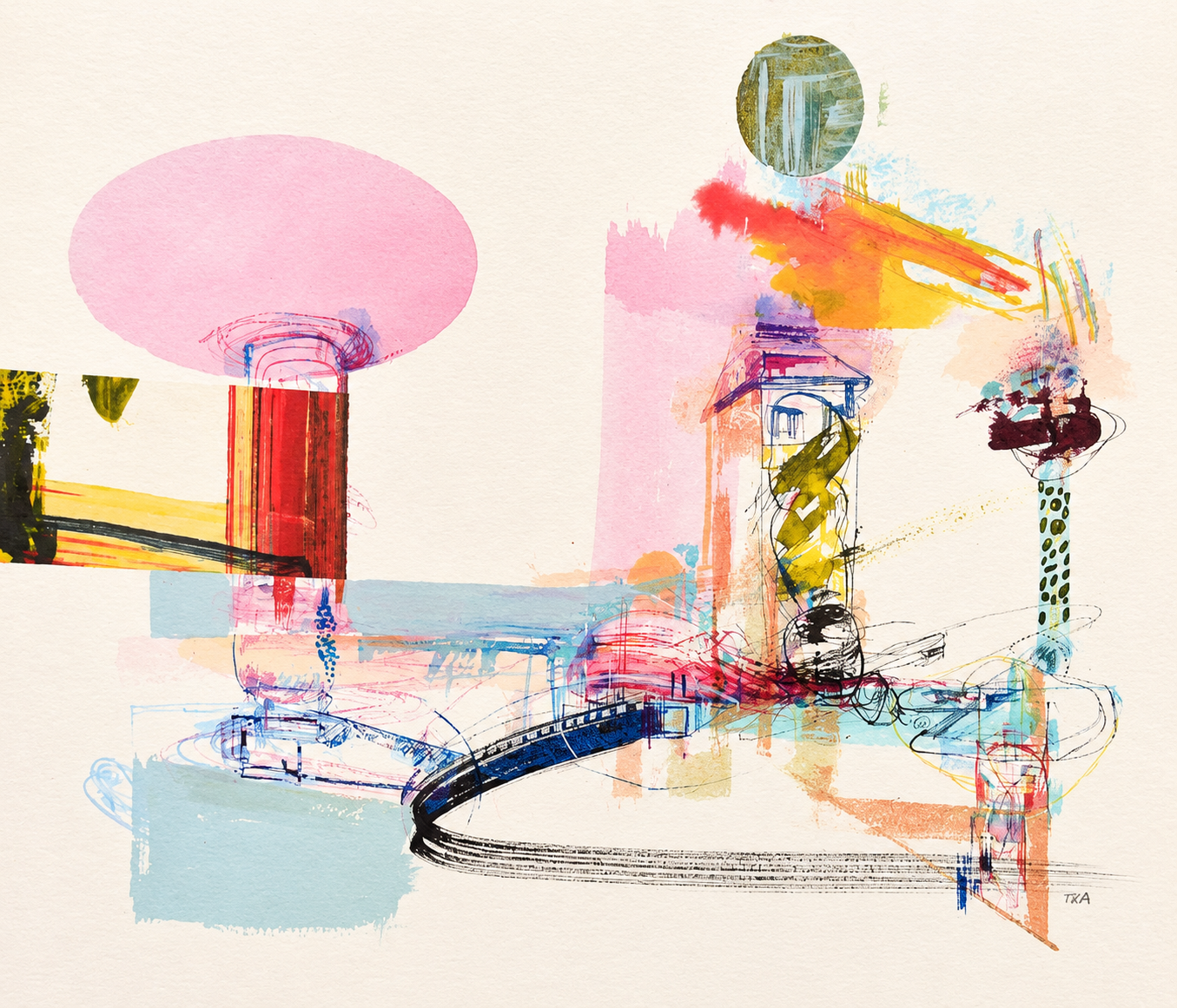
There are artists who approach the canvas with a carefully defined image in mind, and others who enter the studio in search of something unknown. Joxan Iza belongs firmly to the latter group.
Working from his studio in the Basque Country, surrounded by nature and removed from the accelerated rhythm of the contemporary art world, he begins each painting without a predetermined destination.
This idea lies at the heart of Joxan’s practice. Rather than imposing an image onto the canvas, he approaches painting as a process of discovery, allowing possibilities to emerge through the act of painting itself.
Forms overlap, colours respond to one another, gestures are made and reconsidered. The painting develops through this accumulation of decisions and accidents until unexpected relationships begin to establish an internal logic of their own. His works are therefore not illustrations of ideas conceived beforehand, but records of a process in which discovery is as important as intention.
His approach was shaped in part by his years in Paris, where he studied at the École Nationale Supérieure des Beaux-Arts. Living in the French capital gave him access to its museums, galleries, salons and art fairs, while his first encounters with Impressionist painting left a particularly strong impression on his understanding of colour and light.
His references, however, extend far beyond a single movement. Abstract Expressionism, Art Informel, Constructivism and traditional Chinese painting all enter into his visual vocabulary. He cites figures as varied as Jean Tinguely, Gerhard Richter, Vladimir Tatlin, Alexander Rodchenko and Sam Francis, alongside Ernst Haeckel’s Kunstformen der Natur and Constant Nieuwenhuys’s utopian New Babylon.
What connects these seemingly disparate influences is perhaps a fascination with systems that remain open to transformation: structure and chance, order and spontaneity, the constructed and the organic.
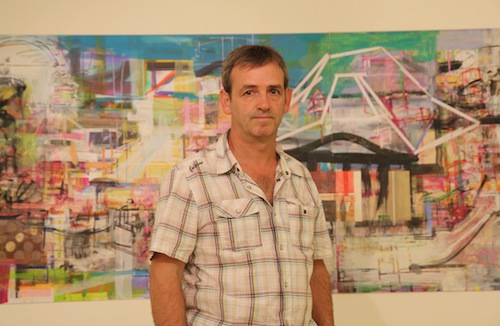
Inside the Studio
The studio itself occupies a particularly important place in this process. Joxan works alone and considers privacy and concentration essential conditions for painting.
Painting becomes an introspective act—a means of accessing emotion, memory and impulses that appear before rational thought. Each canvas develops through a dialogue between conscious decisions and spontaneous gestures until, eventually, something resolves.
Joxan describes the completion of a painting as an insight: a moment of recognition rather than the execution of a predetermined plan. Some paintings arrive at this point almost effortlessly; others demand repeated intervention before their potential reveals itself.
Reading Joxan Iza Through His Paintings
The works currently available through Fernando Durán’s marketplace offer an opportunity to see these ideas materialise across different moments in Joxan’s practice.
In Sin título AA (2020), the composition is comparatively open and restrained. Areas of colour, line and empty space coexist without being forced into a conventional pictorial structure. The work demonstrates how absence can be as active as gesture: the untouched areas allow individual marks and colours to establish their own relationships.
Panoramika I (2008) and Central Park (2008) reveal a denser visual language. Layers of colour and intersecting lines create compositions that seem to oscillate between abstraction and fragments of an imagined urban landscape. Rather than presenting a literal view, they invite the eye to move through the painting, discovering connections between structures, colours and gestures.
The more recent ZATIXAK II (2025) and ZATIXAK XII (2025) show this language evolving further. Colour becomes increasingly atmospheric, while gestures appear to emerge, disappear and reappear beneath successive layers.
Seen together, works separated by almost two decades allow us to trace both change and continuity within Joxan’s practice. His visual language evolves, yet the underlying questions remain: how much can be controlled, how much should be left to intuition, and at what point does a painting begin to reveal something that the artist himself did not anticipate?
This is also what makes living with an abstract painting different from encountering it only once. There is no single narrative that needs to be understood. Relationships between colours, forms and gestures can reveal themselves gradually, while the viewer’s perception of the work can change over time.
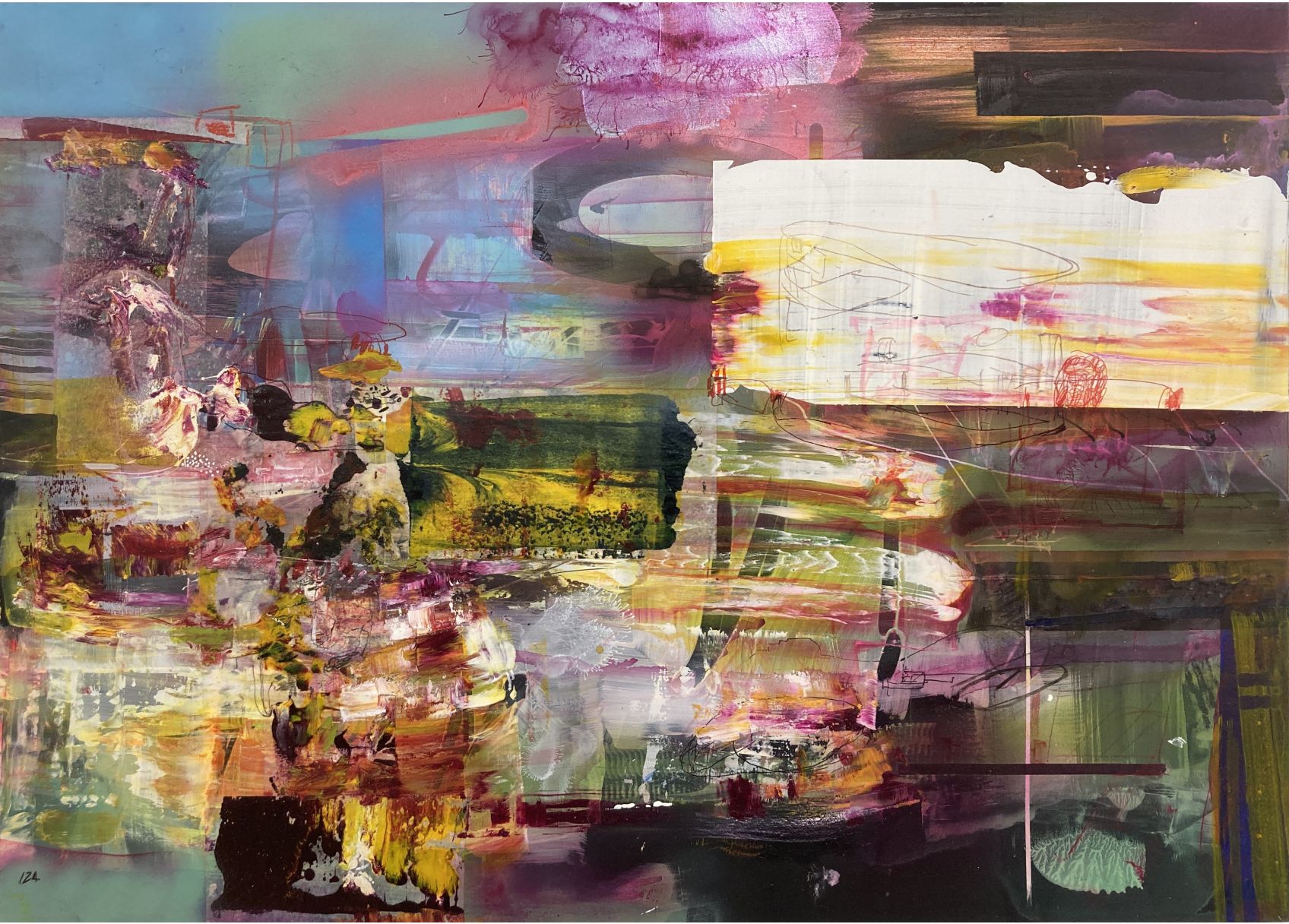
That freedom is central to Joxan’s understanding of what happens when a painting leaves his studio. The artist’s process may have reached its conclusion, but the life of the work has not.
Building a House Over the Treasure
For Joxan, the relationship between a painting and the person who eventually lives with it is not passive. Meaning continues to be constructed long after the work leaves the studio.
When asked what he hopes remains with someone once one of his paintings enters a collection, his answer comes through an unexpected source: the Marx Brothers.
‘There’s a TREASURE underneath that house!’
‘But there isn’t any house.’
‘Then we’ll build one.’
I believe works of art are that house we build over the treasure.” Joxan Iza
It is a wonderfully simple metaphor for Joxan’s understanding of painting.
The treasure is not necessarily something the artist can show us directly. It might be memory, emotion, imagination, instinct—or something that cannot quite be articulated at all. The painting becomes the structure built around it, giving visible form to something that would otherwise remain hidden.
And once that painting enters a collection, another process begins. The collector brings their own memories, associations and interpretations to the work. What Joxan began in the studio continues to evolve through the experience of the person who chooses to live with it.
Perhaps that is ultimately what his paintings ask of us: not simply to look, but to remain curious enough to keep discovering.
At Hargesheimer Kunstauktionen, we are delighted to present a selection of works by Joxan Iza through our contemporary art marketplace.


